
Where creativity meets connection


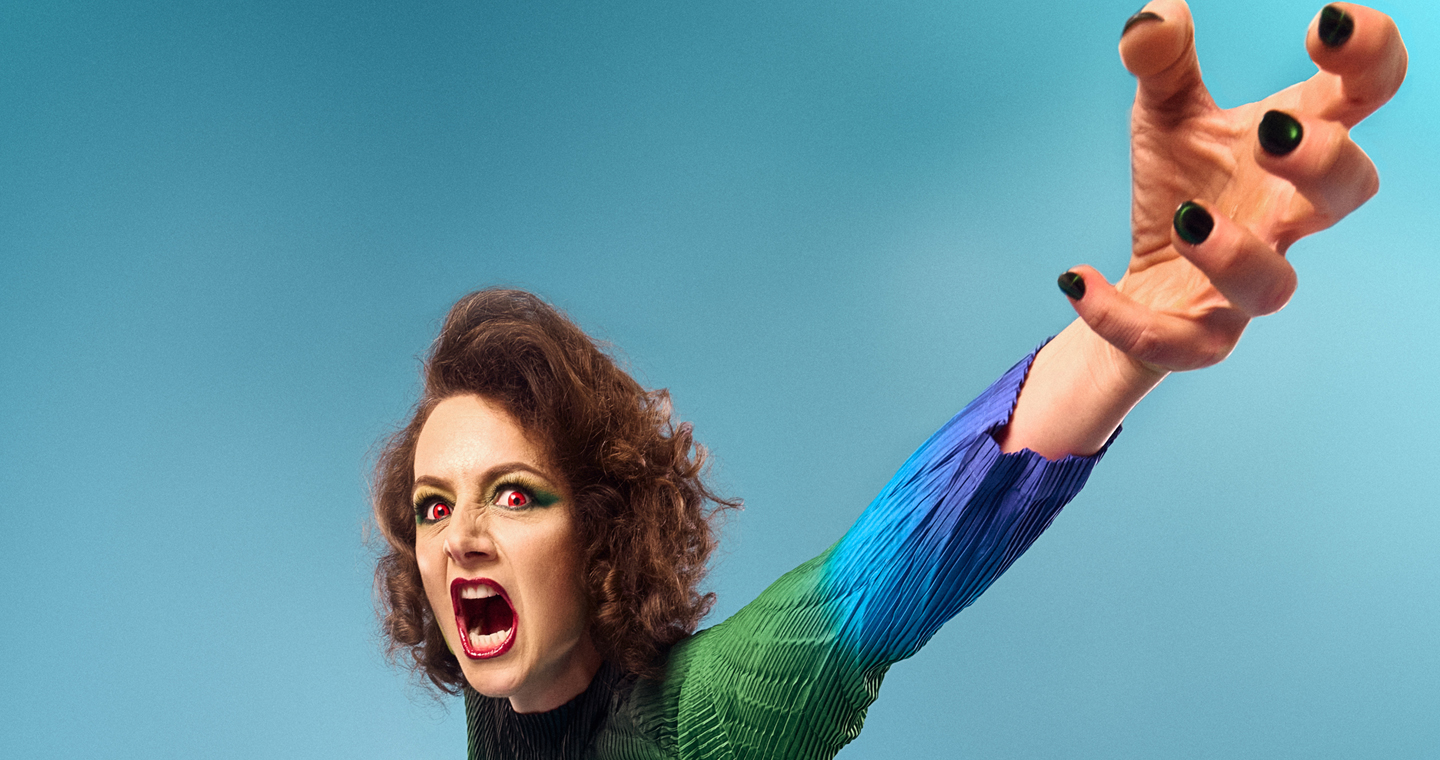
It’s a raw, rainy afternoon, but Jessica Fostekew quickly blows away any cobwebs with her brightness. This buoyancy is now being paired with a resolute, unflinching gaze at the world’s sharp edges in her new show, Iconic Breath. It stands as a neatly constructed guide to tolerance and temperance in a world which is increasingly unpredictable. Opinions calcify, and empathy is in short supply, but perhaps her own background can provide some solution…
Obviously, the execution is far more complex, offering something sharp, reflective, and, in her own words, “committed to staying funny when everything feels bleak.” This new show, she tells me, isn’t about sugar-coating reality, nor about giving in to despair. “I’ve called it the silliest of shows for the darkest of days. That’s what I want to give people right now… permission to feel joy, even when everything around us can feel a bit nightmarish.” She grins, adding: “Laughter matters even more when it’s hard to come by.”
Comedy on the knife-edge
We talk about the challenge of finding balance. In recent years, both in her comedy and as creator of The Hoovering Podcast and co-host of The Guilty Feminist, she’s tackled big themes. But this time, she’s after something looser, and, in its way, riskier. “Previously I was on a bit of a mission,” she concedes. “It was one big story, or me fighting an opinion about something like the diet industry. But, for this show, I wanted to do something different. Either you give people total escapism, or you acknowledge the shambles out there while helping them have genuine fun. This is me trying, always, to straddle both.
“It is a balancing act, though. Was it difficult? Oh my god, yes. It’s really tricky. These days, you can’t just say something, even lightly, certain words or subjects instantly set people off. But you also can’t be too scared to say anything with meaning.”
Fostekew recounts, with both affection and candour, how she mines her life for material: “I talk about my family a lot… especially my Nanna. She was incandescent. She just radiated positivity, not the irritating, chirpy kind, but the kind where you take a terrible situation and ask, ‘What can we make better?’” She tells me there was no moaning accepted in that house. There was an assumption that only boring people get bored. But there was always plenty of space to be fun and cheeky.
But the Fostekew heritage is also salted with fire: “I’m part my dad too! He was the angriest, most exasperated man alive. Hilarious, but always furious. I guess it’s why I straddle that line on stage: resilient joy and righteous rage.”
Navigating a world divided
A big part of her show circles ideas of divided societies. “My son plays football… On the sidelines, you’re thrown in with people who’ve totally different ideas from you, yet you’re friends,” she observes. “There’s something really hopeful in that. Years ago, my parents had friends and acquaintances with all sorts of politics, and it never felt like treason. We owned our views, but didn’t make them our personalities.”
Fostekew is keenly aware of how fraught disagreements have become, especially online. “Social media is such a weird, toxic space for disagreement. You end up arguing with complete strangers, and it just inflames everything. If you disagreed face-to-face, say on those sidelines, or in the pub, you might actually have a proper, respectful conversation.” She sighs. “But online? It makes everything harsher, faster.”
“There’s a peculiar loneliness to it,” she continues. “You think you’re building relationships online, but you’re not, really. They’re parasocial. And for comedians, the spotlight is intense. I’ve been accused of being antisemitic and Islamophobic… On the same day! There’s no room for changing your mind in public anymore, and that’s sad, because changing your mind is kind of the point of living, isn’t it?”
The live show as a sanctuary
Away from online chaos, Fostekew is a fierce advocate of the communal power of the live show. “Getting people in a room, away from their phones, next to strangers, is magic. We forget how radical that is. The questions become: what do I say, what do I make people feel? I want them to feel lighter, to find hope and solidarity, not just escapism but connection.”
She describes the challenge of keeping her comedy fresh, as reality keeps shifting beneath her feet. “The news moves at warp speed now. You can’t write a joke about Thursday’s news and expect it to land by Friday.” She’s adapted by keeping some of her set open, letting the moment gently guide the narrative. “Mostly I go out solo, spend ages chatting, getting the energy of the room. It makes every night different. The more you let go, the funnier it gets.”
Since debuting at the Edinburgh Fringe Festival in 2011, Fostekew has toured a string of smash-hit shows, along with some stand-out appearances on shows like QI, Celebrity University Challenge, and Richard Osman’s House of Games. She’s also lent her quickfire skills to panel shows like The News Quiz and Breaking The News in Scotland. “It’s a different muscle. Stand-up is long stories, shaped and nuanced; panel shows are lightning-fast, sharp jokes. Both keep me present. I love the tension, the pacing.”
Worry, hope, and laughter
Is she concerned about the future? “Of course I worry. Especially about the effect of social media, about how we treat each other,” she admits. “I know how it feels when a fight online ruins your day or just exhausts you. Lots of people, myself included, have sworn off the news sometimes because it’s too much. But I don’t think we’re doomed. This is just a moment we’re passing through.”
She credits her optimism to the women in her family. “Resilient positivity. You find what can still be saved, what can be celebrated. Even with something like the climate crisis, stand-up gives me a way to talk about the hard things. Hopelessness is not an option. I channel my Nanna, I really do.”
Do comics change the world?
Can comedy be a tool for change, or is that too grand a claim? “Not alone, no,” she says. “But it works the way everything works. If we all believe there’s no point, if no one ever recycles or puts up a solar panel, we really are doomed. You do what you can. Comics can share ideas in a room full of strangers that would be too much around the family dinner table. And that can be powerful… from small rooms, big ideas can spread.”
She talks about the divide between a comedian’s on-stage persona and real life: “The longer I’ve done this, the more those two things blur. Early on, I was acting confident; now I just am. Stand-up is so scary for so long. You die up there, you bomb, then… Then you realise the world doesn’t stop turning. Something settles, and you get brave.”
Comedy as a calling
As we talk, what becomes clear is that comedy is a lot more than Fostekew’s job. “Performing is how I process life. I’ve been at this for twenty years. It started as survival, making people in the playground laugh, or deflecting tension at home. But these days, it feels like a kindness. Both to myself and the audience. I want people to walk away feeling seen, feeling lighter. Life is heavy. You need a place to set it down.”
She waxes lyrical about the community she finds in comedy. “You can say stuff in a theatre that you can’t get on the news. It’s not filtered into an easy headline. My job is to make ideas playful, to let people try them on for size without risk.”
Practising what you preach
Asked how she keeps her own hope alive, while juggling stand-up, social commentary, family, and a news cycle that won’t stop spinning, she returns once more to joy and the art of being in the moment. “The show keeps changing because the world keeps changing. I never want to stand still. Sometimes, I’ll go on a news panel and hear a brilliant take that changes how I see something, and I’ll work it into my next routine. Sometimes the audience teaches you the most.”
There’s a humility alongside the ambition to keep growing, which feels rare in an industry built on boldness and egos. “If anyone tells you they know how it all works, they’re lying. I’m learning all the time.”
She tells me she’s driven to do stand-up. There’s no other option. “What else are you going to do? Stay silent? That’s not living. We need each other, and we need to remember how to disagree and still be pals. Comedy’s the best vehicle for that. It lets you hold up the mirror, but it can be a funhouse sometimes.”
Obviously, there are occasional days when the world makes you want to give up, go home and get back into bed. “But if you can bring a roomful of strangers together to laugh at the state of things, and maybe each other a bit, then you’re doing something worthwhile.”
Jessica Fostekew takes Iconic Breath to Brighton Dome Corn Exchange on Thu 26 Feb, Canterbury’s Marlowe Theatre on Thu 26 March and London’s Leicester Square Theatre on Fri 15 May, as part of her 2026 UK tour. Find more information and tickets at: www.plosive.co.uk
All images by Matt Stronge

Stuart Rolt
Featured What's On

Stay in the loop
Keep up to date with latest news, guides and events with the SALT newsletter.


